 Arabic
 English
 Spanish
 Russian
 Romanian
 Hindi
Hindi Tagalog
 Bengali
 Sinhalese
 Nepali


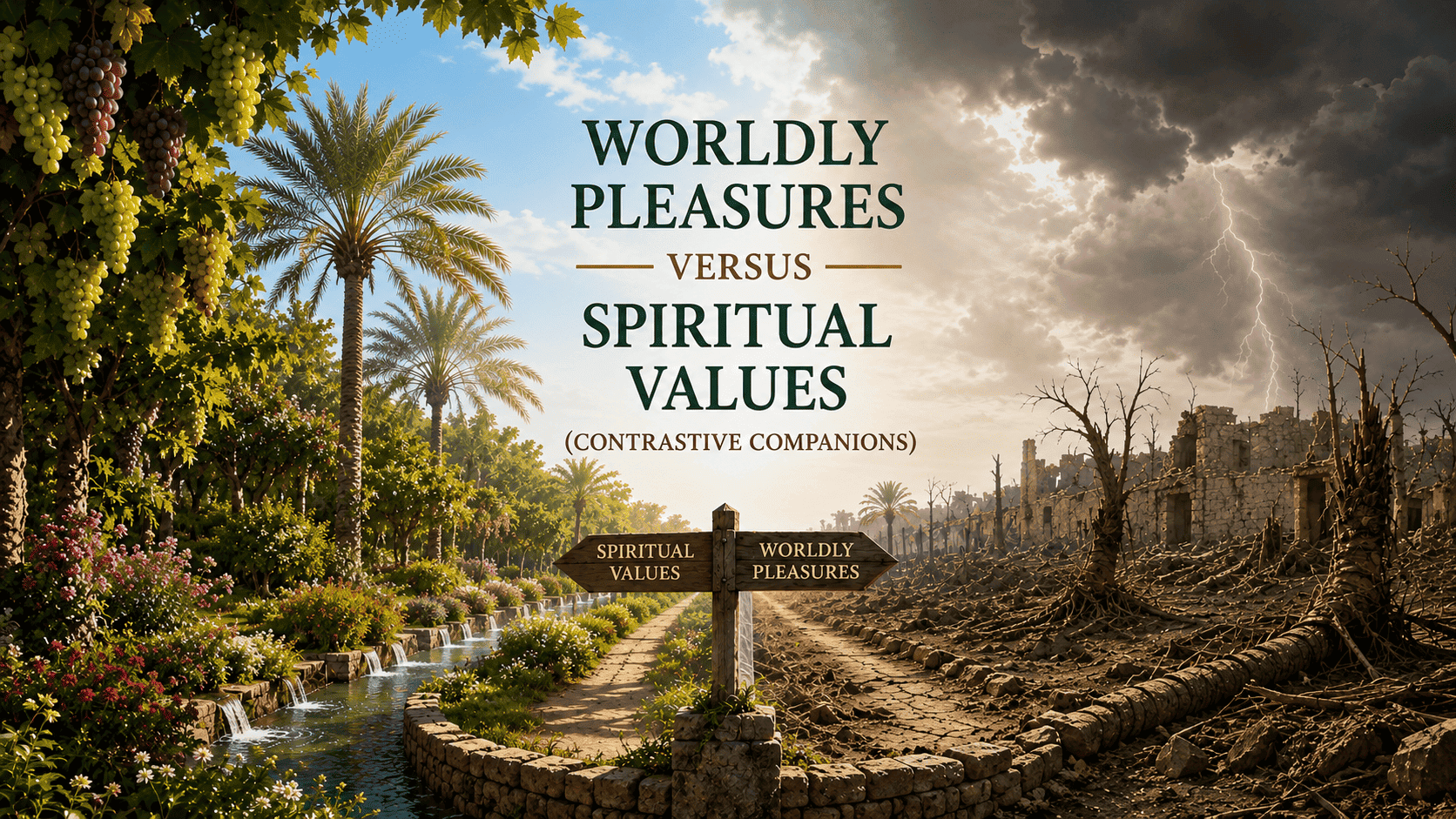
Explore the Quranic story of the two gardens, revealing lessons on gratitude, arrogance, faith, and the lasting value of spiritual wealth.
By Dr. Ahmed Al-Khalidi
Through the following Noble Quranic Dialogue, Allah (SWT) strikes a vivid and alive educational example of two men, one is a believer and the other is a disbeliever. The two men represent two contrasting types of people, the former, though less than his friend in richness and family, represents the category who are proud of their faith and gratitude to the Beneficent for His blessings; whereas the latter represents the conceited rich type who are so proud of their large family and so corrupted by their wealth that they forget their Lord who bestows such blessings upon them.
The setting where the dialogue between the two men takes place is perfectly portrayed: two splendid gardens with fruitful grape trees and blooming green vegetation surrounded by beautiful palm trees and a fresh outpouring river gushing through both gardens actually turned the man’s head; as he was not well equipped with faith in Allah (SWT). So, the conceited rich man forgot the absolute power that domains people’s provisions and life, thinking that such prosperity is eternal and will never perish.
The vanity of the disbeliever
Now, let’s follow the dialogue that took place between the two personalities:
(34) (Abundant) was the produce this man had: he said to his companion, in the course of a mutual argument: “more wealth have I than you, and more honour and power in (my following of) men.”
Moreover, he goes beyond that and ignores the Hereafter saying:
(35)”I deem not that the Hour (of Judgment) will (ever) come”
Not only this, he claims that in case he returns to Allah, he will be given a better garden.
(36)“Even if I am brought back to my Lord, I shall surely find (there) something better in exchange.”
So conceited is the rich disbeliever of the abundance and beauty of his garden, of its stretching shades, its within reach sweet fruits and running fresh water as well as the power of his band that he thinks his garden will neither perish nor its water will vanish.
Ali, (1934) comments on this situation saying:
the two men began to compare notes. The arrogant one was puffed up with his possessions, his income, and his large family and following, and thought in complacency that it would last forever. He was also wrong in looking down on his companion, who though less affluent, was the better man of the two.
The believer’s trust in Allah
On the other hand, the believer says to his disbeliever companion denying his message and at the same time reminding him of Allah’s blessing bestowed upon him; it is Allah who created him originally from dust (Adam’s origin) then from a sperm (Adam’s offspring’s origin) when he was too weak but once he became a strong adult he became ungrateful to Allah and looked down upon his companion.
(37) His companion said to him, in the course of the argument with him: “Dost thou deny Him Who created thee out of dust, then out of a sperm-drop, then fashioned thee into a man?
What’s more is that the believer expresses his contentment and satisfaction in Allah’s dealings with him though he has less property and children.
(38) “But (I think) for my part that He is Allah, My Lord, and none shall I associate with my Lord.
Ali, (1934) explains that,
His companion always supplicates his lord and believes that the blessing is an evident of the One who grants it. Thus, such blessing obligates him to praise and be grateful to his Lord not to forget Him.
– The believer also blames his companion because he does not refer the gift to his Lord pointing out that the best way to enjoy Allah’s blessings is through gratitude to Him. (SWT) (39: Al-Kahf)
(39) “Why didst thou not, as thou wentest into thy garden, say: ´Allah´s will (be done)! There is no power but with Allah!´
However, when realizing his companion’s disbelief, arrogance and ingratitude, the believer prayed for Allah to grant him a better garden and to destroy his disbelieving companion’s garden as it had been the reason of his disbelief and ingratitude in the hope that he may return to Allah (SWT) and believe in Him.
(40) “It may be that my Lord will give me something better than thy garden, and that He will send on thy garden thunderbolts (by way of reckoning) from heaven, making it (but) slippery sand.
(41) “Or the water of the garden will run off underground so that thou wilt never be able to find it.”
Allah’s punishment as a bitter lesson
Actually, Allah (SWT) answered the believer’s prayer and destroyed the disbeliever’s garden. Here, the disbeliever stood gazing at the ruins of his garden twisting and turning his hands expressing his remorse for his disbelief and ingratitude to Allah and sorrow for his great loss.
(42) So, his fruits (and enjoyment) were encompassed (with ruin), and he remained twisting and turning his hands over what he had spent on his property, which had (now) tumbled to pieces to its very foundations, and he could only say, “Woe is me! Would I had never ascribed partners to my Lord and Cherisher!”
What’s worse is that he found nobody to help him nor a son to benefit him. (See: 43)
(43) Nor had he numbers to help him against Allah (SWT), nor was he able to deliver himself.
Victory of the spiritual and ethical values on egotism
At length the disbeliever realized that the sponsorship is only for Allah (SWT), who rewards believers and protects them; but those who are ungrateful and disbelievers will never enjoy the sponsorship of their Lord; accordingly, they will find no helper nor supporter to them and eventually they will lose themselves in both this world and the next world.
(44) There, the (only) protection comes from Allah, the True One. He is the Best to reward, and the Best to give success.
Ali, (1934: 740) analyses the protest of the rich man’s companion:
The companion’s argument divides itself into five parts: 1- He remonstrates against the proud man denying God. 2-He, from his own spiritual experience, proclaims that God is one and that He is good. 3- He points out to him the better way of enjoying God’s gifts, with gratitude to Him. 4- He expresses contentment and satisfaction in God’s dealings with him. 5- He gives him warning of the fleeting nature of this world’s goods and the certainty of God’s punishment for inordinate vanity.
Al-Sa’di, (1998) draws our attention to the bad end of those who enjoy worldly pleasures which distract them from the obedience of Allah, divert them away from the next world and turn them into transgressors, the (accepted) prayer from an oppressed person may destroy the property of those whose wealth and children cause them to disbelieve and lead a stray.
Sayyed, (1978) states that this lesson is a report of values in the scale of doctrine. He adds that Islam does not prohibit the good worldly values, however, they should not be the ultimate goal of man’s life.
Ali, (1934 p.740) concludes that
it was not wealth that ruined him (the conceited rich man), but the attitude of his mind. He was unjust, not so much to his neighbour, as to his own soul. In his love of the material, he forgot or openly defied the spiritual.
Al Baz (2007 p.274), elicits these wonderful educational values out of the dialogue context “the narrative dialogue of the two gardens draws two models of people: the man who is proud of the worldly ornaments and the materialistic values versus the man who is proud of Allah and the spiritual principles.”
Educational lessons:
– He who wants to enjoy worldly pleasures should thank Allah who grants him such blessings.
– Success and victory are the outcome of righteousness and piety.
– The bad end of those who enjoy worldly pleasures that distract them from the obedience of Allah, divert them away from the next world and turn them into transgressors.
– Gifts and worldly pleasures sooner or later will fade away and disappear.
– The (accepted) prayer from an oppressed person may destroy the property of those whose wealth and children cause them to disbelieve and lead astray.
– Believer should advise the unbeliever and guide him to believe in Allah, to confess in His Oneness and to thank Him (SWT) for his blessings and bounty saying:
What Allah willed (has occurred)
There is no power but with Allah!”
– If Allah fails someone, he will never achieve victory.
– – Looking down upon people because of wealth may lead to Allah’s anger.
– The real values are not wealth, nor rank nor the property of this world as they are vanishing.
– That’s why rich people should be modest with the slaves of Allah and avoid transgression and arrogance.