 Arabic
 English
 Spanish
 Russian
 Romanian
 Hindi
Hindi Tagalog
 Bengali
 Sinhalese
 Nepali


By Faisal Alzamel
Abu Yusuf, one of the disciples of Imam Abu Hanifah, recounted: “My father passed away when I was just a young child in my mother’s care. She sent me to a tailor to learn his trade, but I would often slip away from the tailor’s workshop to attend the study circle of Abu Hanifah. My mother would come to the mosque, take me by the hand, and bring me back to the tailor.”
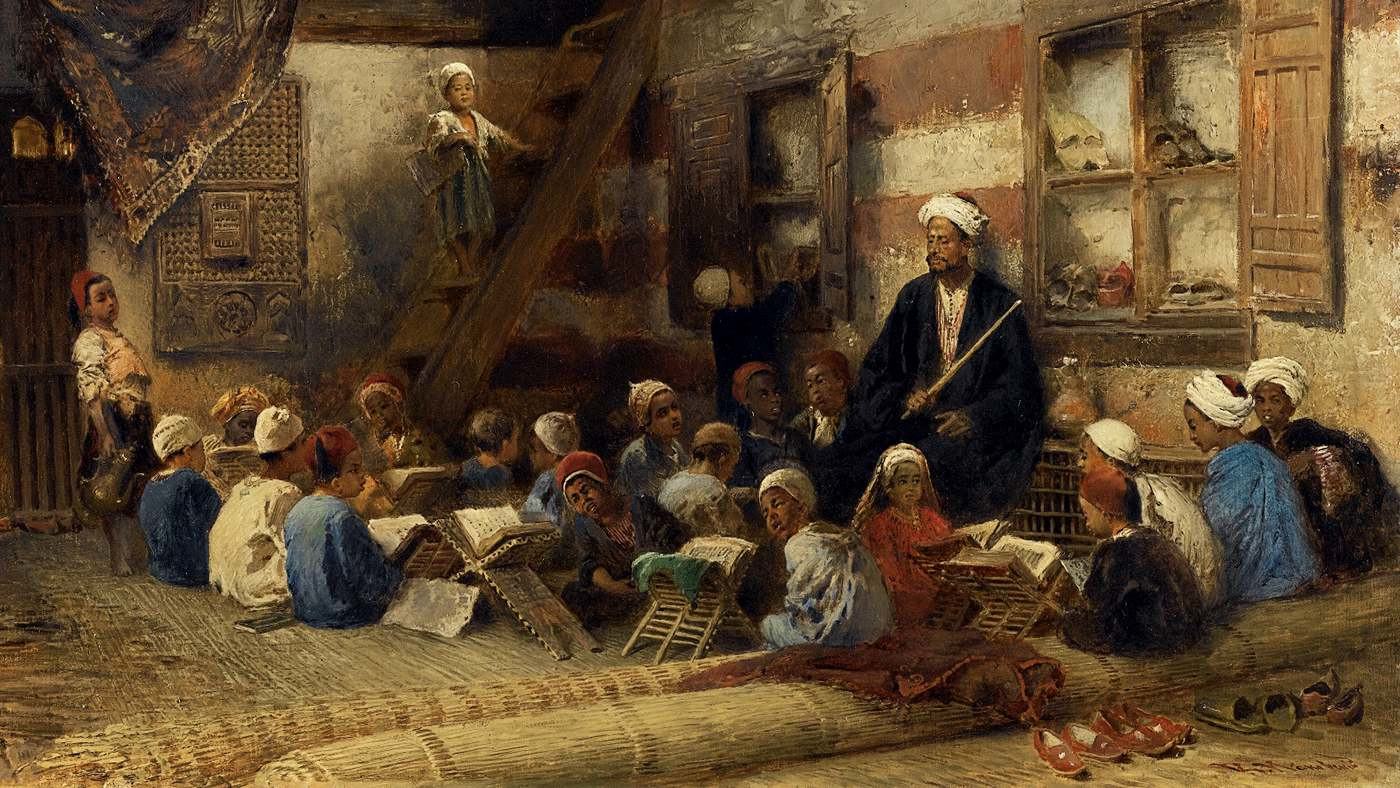
My mother would come to the mosque, take me by the hand, and bring me back to the tailor.
Abu Hanifah noticed my passion for knowledge and would draw me close, teaching me himself. After my absences from the tailor became frequent, my mother went to the mosque and confronted Abu Hanifah: ‘This boy’s corruption is your doing! He is an orphan, our sole provider, and you are diverting him from the craft I sent him to learn.’
Abu Hanifah replied to her: ‘Let him be. He is learning to partake of Faludhaj made with pistachio oil.’
She retorted, ‘Faludhaj with pistachio oil? That is a delicacy fit only for a Caliph! By God, you are an old man who has lost his wits!’
Nevertheless, I remained steadfast with Abu Hanifah, learning from him until his death (may God have mercy on him) after which I succeeded him in leading his circle. When my reputation grew, Caliph Harun al-Rashid summoned me and appointed me as a judge. One day, I visited him in his court. When food was brought to him, he offered it to me and said, ‘Eat, Abu Yusuf.’ I tasted a dish more exquisite than any I had known before. He asked me, ‘Do you know what you have just eaten?’
I replied, ‘No.’ He said, ‘This is Faludhaj with pistachio oil.’ I could not help but smile. When he asked what amused me, I recounted the story of my mother and Abu Hanifah.
The Caliph said, ‘May God rest Abu Hanifah’s soul. He saw with his mind’s eye what others could not perceive with their own. A single moment of faith from Abu Hanifah is what shaped Abu Yusuf. It makes one wonder: have we truly learned to believe in our own children and students?’
What Abu Yusuf achieved was ultimately by God’s grace, yet it was also born from Abu Hanifah’s belief in him. Imagine if Abu Hanifah had not believed in his student and had simply left him to his mother’s wishes. In all likelihood, his destiny would have been that of a tailor in the marketplace; he would have died unknown to the world. That moment of faith from the master in his pupil is what appointed him to the judiciary, ushered him into the court of the Caliph, and bequeathed to us Abu Yusuf’s critical reviews, his elucidations of his master’s jurisprudence, and even his corrections to it. Without this belief in another, Abu Yusuf would not merely have been lost—a great body of jurisprudence we benefit from today is the direct fruit of Abu Hanifah’s faith!
So many talents have faded into oblivion, so much brilliance has been extinguished, simply because they found no one to believe in them, to lift them from obscurity and set them upon the right path.
There is no cruelty greater than the suffocation of dreams and talents. Believe in your children. Nurture their wings, adding feathers rather than clipping them—even if their talent lies in a path you yourself do not believe in!
—————————————-
Excerpted and adapted from the book History of Baghdad